








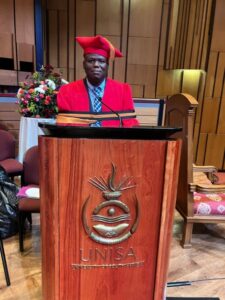
 Selatswa Johannes Masenya (46) has recently been awarded a PhD in Information Science, adding the title of doctor to his name. However, he humbly emphasises that the true significance of his achievement lies in its contribution to research rather than the title itself.
Selatswa, the Assistant Director for Library and Information Services (LIS) in Region B, has served as a librarian in the City for over 20 years, holding operational and managerial positions. His journey with the City began in 2002 when he joined as an intern librarian. Over the years, he progressed to senior librarian roles and eventually transitioned into managerial positions.
As Assistant Director, Selatswa oversees LIS programmes in Region B, ensuring alignment with the City’s priorities, LIS Business Plan, and City’s Growth and Development Plan. His responsibilities include interpreting and ensuring the execution of policies to guide the provision and development of LIS in the region.
Selatswa earned his doctorate from Unisa during the October 2024 graduation ceremonies. His thesis, titled “Employee Retention Model for Public Librarians in Gauteng Province: Implications for the Performance of Librarians and Libraries”, investigates the factors affecting librarian retention.
His research examined key retention factors such as training and development, career opportunities, leadership, compensation, and fringe benefits. Drawing on questionnaires and interviews (concurrent mixed methods design) conducted with participants from seven municipalities, Selatswa adopted a mixed-methods approach, culminating in a conceptual employee retention framework.
The research was inspired by concerns he uncovered during his Master’s studies in 2019, where he found that 50% of librarians in the City of Johannesburg were considering leaving their roles. “This thesis is the culmination of my Master’s degree findings. Back then, I discovered that 50% of librarians intended to leave libraries within the City of Johannesburg. My PhD sought to validate and expand on those findings,” he says.
Selatswa acknowledges the challenges he faced during his academic journey. “It was mentally taxing, but intrinsic motivation and the unwavering support of my wife and children kept me going. During my final year, I studied alongside my daughter, who was preparing for her matric exams, and we inspired each other.”
Born in Sefateng- Ga Dikgale, a village outside Polokwane, Limpopo, Selatswa was raised by his grandparents while his mother worked as a domestic worker. His grandfather, who instilled in him a deep appreciation for education, played a pivotal role in his success. Despite limited resources, his grandfather paid for his university studies during his second year at the University of Limpopo in 1998.
“I plan to take my doctorate to my grandfather’s grave who passed on in 1998 and sing,” Selatswa says, reflecting on the profound influence his grandfather had on his life.
Outside of work, Selatswa enjoys hiking, spending time with his family, and reading. He also advocates for self-belief, advising others: “Always trust in your abilities and never doubt yourself.”