



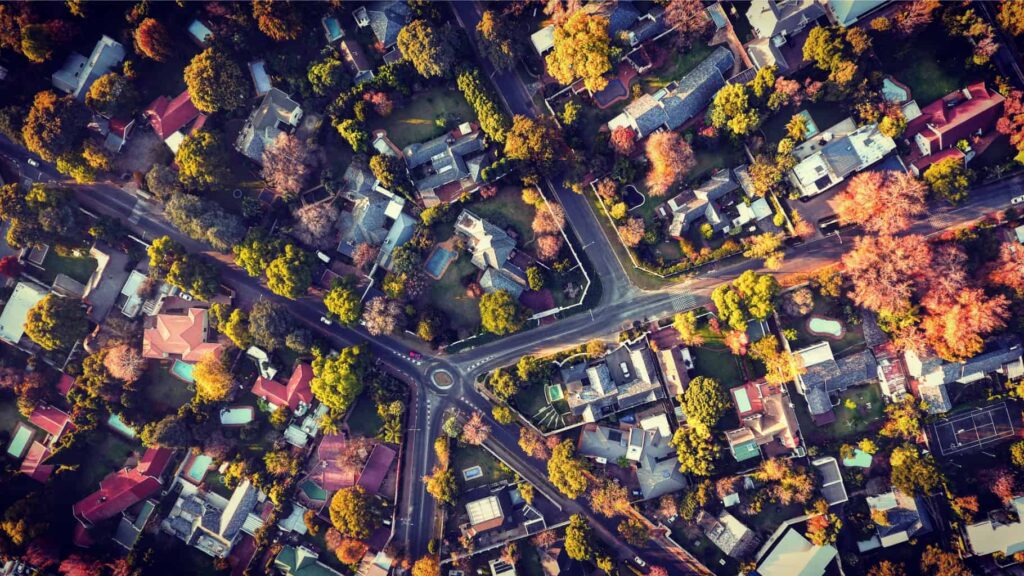






The City of Johannesburg uses digital Geoinformatics for a range of functions, including resource and infrastructure inventory, street name provision, and street address management, as well as land-use management, zoning, and town planning.
Other Geoinformatics applications used include digital mapping systems for public data provision; health care planning and monitoring of public health risks; city service proximity analysis; and transportation planning and service routing.
The City also deploys Geoinformatics for law enforcement on developments, emergency management services, disaster response, housing, human settlement strategies, and overall land administration, among other things.
Roxanne-Pyal Parthab, a Geographic Information Systems (GIS) Specialist at the Directorate for Corporate Geo-Informatics (CGIS), describes the City’s deployment of Geoinformatics best.
“It’s the science of ‘where,’ answering questions like what is where, why, when, and how,” Parthab explains.
She says Geoinformatics is the broad, overarching discipline concerned with using various forms of scientific infrastructure, technology, information systems, and geographic data to solve problems in the built environment. It informs decision-making around the human-environmental nexus.
Geoinformatics comprises several interconnected branches of study, including geography, GIS, engineering, spatial statistics, survey, geometrics, remote sensing, and geodesy, among several other disciplines that inform urban planning.
Parthab says the City’s Development Planning Department is the custodian of “space” in the municipality and the building block of space as a “land parcel” or “property”. The Property Value Chain in the Land Information System (LIS), which is the City’s sole source of property information, manages the life cycle of a property, and all other systems feed off this source of information. If a property is not on the City’s GIS, it cannot be billed.
“Geoinformatics thus plays a crucial role in the management of land parcels within the City’s jurisdiction. The electronic map with data about every property within the City is captured, maintained, and linked to various systems that ensure the correct provision of municipal services as well as maintain accurate billing records. Geoinformatics is a core component of the municipality’s Property Value Chain, linking property (land), a person (ownership), and metre (services and billing),” Parthab adds.
She says Geoinformatics and spatial planning are inextricably linked. “Most spatial planning and design processes require the use of geographic-enabled datasets and various geo-processing tools. One branch of Geoinformatics is spatial statistics, which governs fundamental spatial planning concepts. Geoinformatics informs the process of urban planning and design through the facilitation of spatial data analysis and modelling.”
Some aspects of geo-information work in real-time, including satellite imagery, remote sensing, data, and visualisation dashboards. There are various GIS location services available, and there are various GIS real-time tools applicable, such as the GeoEvent Processor and 3D City Engine.
Most of the geographic data used by town planners are not real-time data but spatially accurate representations of the ground, captured or updated daily by Corporate Geo-Informatics, ensuring essential datasets which are not captured in real-time are still up-to-date and as accurate as possible for town planners to use.
All data collected by the City’s Geoinformatics system, including records captured by the Cadastral, Zoning, and Street Address sections, is stored on the CGIS database that runs on the SQL server.
“The database administrator assigns rights to the different sections based on their differing roles so that each team can only update their section’s data, thus minimising the possibility of errors and inaccuracies in the capturing sections. Data that has been modified or updated is replicated to the RGDB (reporting) database, which is the data that the website displays. The data also gets replicated to the LIS_PROD database that runs on DB2, which is used to send information to the Rates, Valuations, and other City departments.”
Parthab adds that more than 80% of all municipal information has a spatial context and can thus be linked to a map. Furthermore, a GIS is the only tool that can integrate information from various sources and link it spatially for analysis.
“It is thus the ideal decision-making tool for informed decision-making in a diverse environment such as local government.”
The good news for everyone interested in learning more about Geoinformatics is that there’s a virtual training course available on the CGIS online maps portal. It’s free and incorporates an introduction to the City’s online maps website. To book a session, email Roxannep@joburg.org.za or ims@joburg.org.za with the subject “Online Maps website training”.
Training is offered Mondays to Fridays between 12pm and 2pm, by booking and invitation only. The training is open to both City employees and the general public.
Written by Brümilda Swartbooi
24.08.2022