









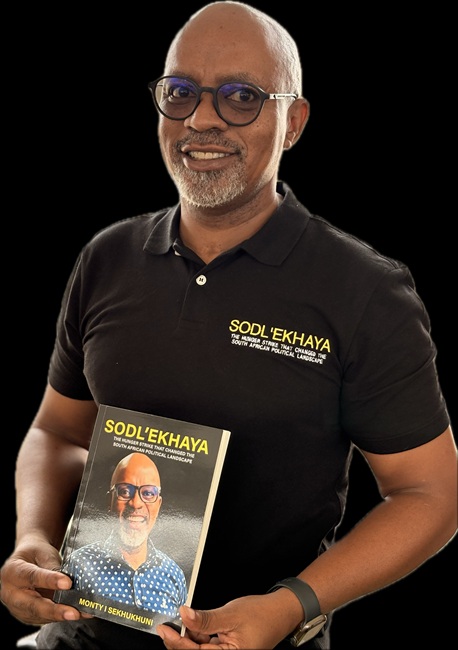
 Monty Ignatius Sekhukhuni (53) has added an important chapter to South Africa’s historical record with the release of his new book which will serve as an educational resource for generations.
Titled Sodl’ekhaya: The Hunger Strike that changed the South African Political Landscape, the book marks his debut as an author and is written primarily in English, with touches of isiZulu, Setswana, and Afrikaans woven in.
Sekhukhuni, who serves as Director of Planning and Strategy at Development Planning, says detainees embarked on the hunger strike on 23 January 1989 and it became a turning point in the country’s political struggle. In the book, Monty writes about what unfolded behind the walls of prison and about stories many have never heard.
The book delves into the hunger strike of 1989 when political detainees risked their lives to demand freedom and justice. It focuses mainly on three pillars: strategy, leadership and organisation. Drawing from his own experiences, he illustrates how these elements shaped the hunger strike and guided detainees.
“The book highlights strategic leadership and the role of the organisation to move things forward and I speak about how organised we were inside prison,” says Sekhukhuni.
He reflects on the unity that prevailed among detainees. “I mean, we have never fought. There were tensions amongst us. We’re human beings, all irritated by somebody at some point. But these things that we hear about a prison life, a common prison lifestyle, it was not there at all. We took care of each other as brothers,” he says.
The narrative goes deep into how the strike was planned, the strategies that were executed, and the leadership that kept detainees hopeful. Sekhukhuni says it was the consistent presence and commitment of ethical leadership that strengthened their resolve.
“We were sick and tired of being fed in prisons whilst kept without a trial. The masses cannot lead themselves they need leaders to shape their perspective,” he says.
Though rooted in a political moment, he says it’s not a political book but a guide to strategic leadership drawn from his experience.
The first chapter was challenging to write because it delves into his personal journey in activism. Raised in Soweto and living with severe eye problems, having undergone 18 operations so far, he recalls navigating detention, torture, and exposure to teargas, challenges he endured without letting go of his mission. Activism also shaped his personal life. He met his wife through their shared commitment to the struggle.
With his first book out, Sekhukhuni is already working on his next project, Beyond Politics. He also hopes to establish a platform that will help aspiring storytellers break into the publishing industry, ensuring that more voices and histories find their place in South Africa’s narrative.
Written by Brümilda Swartbooi