

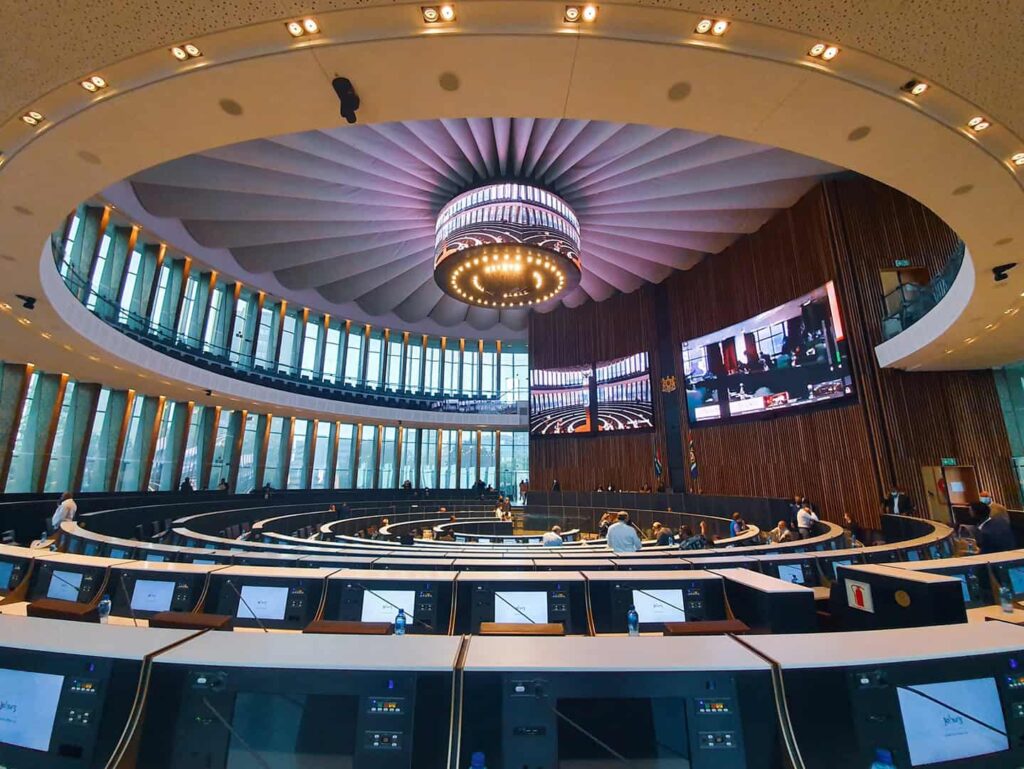






The City’s Environment and Infrastructure Services Department (EISD) hosted a panel discussion in anticipation of the official launch of the City’s Water Security Strategy. The Water Security Strategy has become the official document. It is intended to guide Johannesburg’s transition into a water-secure and water-sensitive municipality. It received endorsement from the Mayoral Committee and consequent approval from the Council on 31 October 2023. The Water Security Strategy is geared towards addressing threats to the City’s urban water cycle while also capitalising on opportunities to transform Johannesburg into a sustainable, resilient, and adaptive city. With seven strategic responses and 67 action plans developed for both short and long-term implementation, the strategy aims to ensure sustainable water management and future water security.?
The panel discussion was conducted under the theme “Leveraging Water for a Resilient, Livable, and Sustainable Environment”. Water sector experts deliberated on various topics, including diversification of water supply sources, protection of ecosystem amenities for improved water quality, nurturing a water-conscious society, and water digitisation.
The extensively consultative approach to formulating this strategy involved a comprehensive review of the current state of the urban water system under the City of Johannesburg’s jurisdiction.
This included identifying key challenges faced by the municipality presently and in the foreseeable future.
During his presentation, Prof Mbangi Nepfumbada from the University of Johannesburg said: “The City of Johannesburg and similar cities face pressure on water demand from various regions. Besides pioneering initiatives, the city must assess the impact of these demands in terms of carrying capacity and the necessary diversification of local water supply.”
“Merely acknowledging the problem won’t suffice. We need a paradigm shift to enable sustainable provision of services across the board,” added Prof Nepfumbada.
Bonginkosi Xaba from Joburg Water said: “The City’s non-revenue exceeds 44%, indicating significant water loss from household consumption and infrastructure inefficiencies. Educating consumers about water conservation is crucial to mitigate high consumption and preserve this precious resource for future generations.”
Tendamudzimu Mathagu from the City of Joburg’s Environment and Infrastructure Services Department highlighted the important relationship between water resources and natural biodiversity, and how much it is important for water security to conserve and nature our environment. Groundwater resource recharge and quality is very much dependent on healthy rivers and wetlands, as well as managing alien invasive plants which tend to be intensive on water suction and thereby reduce available quantities.
Several questions were raised, including concerns about borehole drilling exacerbating water scarcity and the financial constraints causing delays in infrastructure replacement.
Responding to these queries, management clarified that while borehole drilling contributes to water supply diversification, regulation and monitoring are essential for safety and sustainability.
?Households are required to apply and register with the Council before drilling boreholes.
Additionally, infrastructure replacement, aimed at reducing leakages, is outlined in the Water Security Strategy. Financial constraints remain a primary obstacle to expedite replacement efforts.
The Executive Mayor of the City of Johannesburg, Cllr Kabelo Gwamanda, is set to officially launch and unveil the Water Security Strategy as a public document in the coming weeks.
Written by Dudu Lushaba
20/03/2024
Joburg Pulse Radio: https://www.joburg.org.za/media_/Pages/Radio-pulse.aspx