







​​Finance​

Overview

Group Finance Cluster Overview 
The finance department is the engine providing strategic financial leadership to the City of Johannesburg. It co-ordinates the City’s efforts through the formulation and enforcement of policies, rules and regulations to bring about sustained financial health and good governance, and the provision of appropriate, equitable and affordable services to residents.
 
The department’s guiding principles are:
• Professionalism and observing protocol requisites;​
• Accountability and discipline;
• Innovation –  nothing is considered impossible; and
• Team spirit and teamwork.
 
Monitoring and maintenance of ethical governance is done in conjunction with relevant stakeholders.
The department also helps to co-ordinate and integrate cross-functional portfolios. It is responsible for the development of financial frameworks for the City’s 14 municipal-owned entities, which are owned and controlled by the council. It acts as the intermediary between the municipal-owned entities and the City’s core administration, and ensures the municipal-owned entities’ compliance with various legislative and government regulations, including the Municipal Finance Management Act (MFMA).
 
The department falls under the member of the mayoral committee responsible for finance, MMC Cllr Margaret Arnolds​.​

Unless otherwise instructed by the Council, the Finance Committee shall consider and make recommendations to Council on the following matters :

 
A. LEGISLATIVE ROLE
 
IDP, Budget and By-law Process​
1.The consideration and oversight of the development of the IDP and budget in respect of the Finance and Revenue and Customer Relations Management Department.
2.The consideration of the quarterly performance reports of the Finance and Revenue and Customer Relations Management Department.
3.To exercise oversight over the development and implementation of all by-laws, strategies and policies of the Finance and Revenue and Customer Relations Management Department.
4.The consideration and oversight of draft tariffs, fees and charges in respect of Finance and Revenue and Customer Relations Management functions in the City.
 
B. PARTICIPATORY AND REPRESENTATIVE ROLE
 
1.Promote public participation in the Committee's activities
2.Promote public participation in the key planning processes of the City as they relate to Finance and Revenue and Customer Relations Management Department.
3.Ensure that key issues of public concern relating the Finance and Revenue and Customer Relations Management Department are brought to the attention of Council.
 
C. OVERSIGHT ROLE
 
1.Exercise oversight over the quarterly/annual performance of the Finance and Revenue and Customer Relations Management Department.
2.Exercise oversight over any matter referred to the Committee by the Speaker, Council and/or its Programming Committee.
3.Exercise oversight over any matter or activity of the Finance and Revenue and Customer Relations Management Department that will be of concern to the Committee.
4.Invite the MMC or any official of the Finance and Revenue and Customer Relations Management Department to account on any matter of interest to the Committee.
 
D. REPORTS/RECOMMENDATIONS TO COUNCIL
 
1.To make recommendations to Council as a result of the oversight process outlined above.
2.To report quarterly/annually on the oversight activities of the Committee.
3.To report on the oversight visits of the Committee.
4.To submit proposal/comments on Provincial and National Bills and proposed policies affecting local government.​
Vision and mission
The department's vision is to create "a customer-focused city that is able to finance affordable and equitable delivery and development, and that maintains financial stability and sustainability through prudent expenditure, sound financial systems and a range of revenue and funding sources".
 
This means that Johannesburg will be a financial sustainable city; there will be stable and increasing revenue streams; and the cost of providing services will be actively monitored.
 
The mission is "to build effectively functioning business units and ensure effective financial management of the city".
 
Key focus areas

​There are several key focus areas for the financial management and strategy of the department:

Create financial balance between the municipal entities and core administration;

Ensure compliance with relevant legislation, regulations and governance practices;

Ensure the implementation of the Municipal Finance Management Act (MFMA);

Achieve unqualified audits for itself and its entities from the auditor-general through re- establishing the financial control environment;

Improve monthly financial management reporting;

Create a comprehensive Generally Accepted Municipal Accounting Practice (GAMAP) compliant asset register;

Address various accounting difficulties in revenue, particularly in correctly allocating billed revenues and collected cash among utilities; and

Manage and fund liabilities mainly related to post-retirement employee benefits. ​​

The finance department champions financial sustainability for the City of Johannesburg. Its key five-year strategic objectives are largely based on the goals of the financial sustainability sector plan:​

 
  • Empowered customers, enjoying the highest standards of customer care and responsiveness;
  • Implementation and management of new rates policy with minimum disrupti on;
  • Revenue optimisation;
  • Sustained excellence in financial management;
  • Stabilisation of fiscal architecture within which the city operates;
  • A budget structure and format that enables sound resource allocation decisions;
  • Development of an integrated asset management plan and system;
  • An increase in the percentage of operating expenditure budgeted and spent on maintenance;
  • Availability of cost effective capital finance to fund the capital programme;
  • Measurable improvements in unit costs and allocation efficiency from a set of key indicators;
  • Long-term domestic credit rating improvement to at least AA;
  • Achievement of clean audit;
  • Completion of Project Phakama reforms to ensure full business process integration across the revenue value chain; and
  • Equitable and competitive tariff systems that are informed by national inflation data and targets, comparable metros and the circumstances of residents, to ensure affordability. ​​​


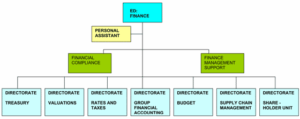
Seven directorates and two support units

There are two support units and seven directorates: Support units
 
Financial com​pliance:
Financial management support
This unit gives strategic guidance to the City’s group chief financial officer by providing efficient and effective support. 

The finance department champions financial sustainability for the City of Johannesburg. Its key five-year strategic objectives are largely based on the goals of the financial sustainability sector plan:​

 
  • Empowered customers, enjoying the highest standards of customer care and responsiveness;
  • Implementation and management of new rates policy with minimum disrupti on;
  • Revenue optimisation;
  • Sustained excellence in financial management;
  • Stabilisation of fiscal architecture within which the city operates;
  • A budget structure and format that enables sound resource allocation decisions;
  • Development of an integrated asset management plan and system;
  • An increase in the percentage of operating expenditure budgeted and spent on maintenance;
  • Availability of cost effective capital finance to fund the capital programme;
  • Measurable improvements in unit costs and allocation efficiency from a set of key indicators;
  • Long-term domestic credit rating improvement to at least AA;
  • Achievement of clean audit;
  • Completion of Project Phakama reforms to ensure full business process integration across the revenue value chain; and
  • Equitable and competitive tariff systems that are informed by national inflation data and targets, comparable metros and the circumstances of residents, to ensure affordability.
Treasury office

This unit is responsible for managing centralised treasury functions. It acts as the City's central banker, managing the primary bank accounts, borrowings, investments and financial risk management for the City and its entities. It is also responsible for managing and co-ordinating financial planning and monitoring and reporting on expenditure trends and activities as well as for improving compliance with legislative requirements.

Four units fall under the  treasury office and these are:
  • Investor Relations
  • Risk
  • Operations
  • Dealing
  • Valuations 

The valuations unit is responsible for the development and implementation of the City's general and supplementary valuation rolls, in terms of relevant legislation.

​Property rates are based on the market value of a property - the value of the land and all improvements - as stipulated by the Municipal Property Rates Act (MPRA). For more information about how the City values each rateable property and calculates the rates, read here.
 
  • Key information on rates
  • Property Rates Policy
  • Rates policy
  • Proposed changes to rates policy
  • Review of the rates policy
  • Public meetings on rates information
Rates and taxes 
Rates and taxes is responsible for developing and reviewing Johannesburg’s Rates Policy and for ensuring effective billing of rates; compliance with the MFMA; and overseeing the application, monitoring, and evaluation and maintenance of uniform standards across the revenue value chain workstreams.
 
All property owners – both those who own freehold properties and sectional title holders – must pay property rates. Read here for more information on rates.
 
Group financial accounting 
The directorate enables an effective environment to ensure compliance with acceptable financial and accounting practices; to ensure that the City maintains an effective, efficient and transparent financial and risk management and internal control systems; to provide financial administration functions; and to provide group financial reporting.
 
Budget office
The budget office endeavours to develop a budget that is in line with Johannesburg’s developmental needs and the challenges it needs to address.  It manages and co-ordinates financial planning and monitors expenditure. It also looks at and reports on expenditure trends and improves compliance through legislative requirements.
 
Supply chain m​anagement 
Supply chain influences the way the City uses its resources to achieve its objectives. The unit ensures that goods and services are procured and, where necessary, disposed of in a fair, equitable, transparent, competitive and cost-effective manner.
 
Shareholder unit
The shareholder unit’s mandate is to monitor the governance of the municipal-owned entities with a view to maximise shareholder value in the interest of the Joburg community.
 
This is done through the maintenance and development of infrastructure while financial viability and sustainability is optimised through the use of assets. It focuses on financial evaluation and monitoring, governance, strategy formulation, business planning, stakeholder management, stakeholder value optimisation and other related portfolio management services of the MOEs. 

​​Consumer information​
Sectional Title brochure;
Information for property owners on the valuation roll;
Information for sectional title owners; 
Rates press releases;
Pensioners living in sectional title properties given until
end September;
City to extended opening hours of customer service centres;
City appeals to sectional title property owners to confirm their details;

 
Rates Policy
The Rates Policy guides the City in all aspects of levying rates on property owners. It also defines the different categories of property, as well as specifies the categories of property ownership that may qualify for rates rebates and exemptions under the MPRA.
Review of Rates Policy 
 
  • Proposed changes to the rates policy
  • Review of the rates policy
  • Public meetings
  • Annual report for rates and taxes
  • Sectional Title Owners
​Report change of postal address for statements
Everything you need to know about managing your municipal account. Click here to access the Sectional Title Brochure. [pdf: 1.3Mb]
Frequently Asked questions on Sectional Title Property.
We need your information - click here to complete the online form.  

Contact Us

Sinovuyo Mpakama

011 242 1043
082 604 5103
SinovuyoMpa@joburg.org.za

Eugenia Bosch
EugeniaB@joburg.org.za
011 242 1047​

Search

Looking for something? type in the search box below, and we will try to find it for you.