





Economic Development
Overview
The Department of Economic Development is mandated to provide strategic economic direction to the City and help steer the City as a whole towards the goal to achieve 5% economic growth and to reduce unemployment by 2021.
The Department is also mandated to drive the implementation of the City’s approved economic development strategy which has a longer term horizon beyond the 5% growth target.
The economic development strategy emphasises the following:
- Shift to increased localisation of production – replacing imports through getting firms in Johannesburg and South Africa to become competitive suppliers;
- Shift to increased economic activity in different regions of the City – promoting increased economic growth in regions based on their different profiles and comparative advantages;
- Shift to increased small business and entrepreneurship activity – through increased collaboration with the private sector value-chains and City supported-SMME Opportunity Centres; and
- Shift to increased connectivity with the rest of Africa through increased trade and investment links with the rest of Africa, including targeted development of economic precincts that reflect Johannesburg as the economic hub of Southern and Eastern Africa.
- Support the alignment of City plans and policies towards achieving a 5% economic growth rate and to bringing down unemployment by 2021.
- Support and promote the development of Small Medium Micro Enterprises (SMMEs).
- Facilitate the creation of an enabling environment that attracts investment and provide dedicated incentive packages for investors with a focus on the Inner City.
- Entrenching Johannesburg as a leading tourism destination brand in collaboration with key stakeholders.
- Enhanced collaboration with public and private sector stakeholders.
- Ensure business regulation, compliance and enforcement of the informal trade sector.
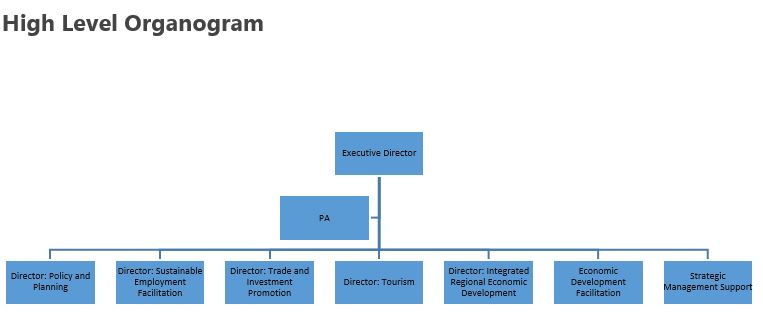
Departmental Structure
The department is headed by the Executive Director, Thembeka Mhlekwa. The Economic Development Strategy for the City of Johannesburg supports the City’s Joburg 2040 vision.
- Retain and consolidate existing viable businesses and centres of excellence;
- Attract new businesses and investment, including those in the manufacturing sector;
- Support the development and growth of micro-enterprises and small and medium-sized enterprises;
- Achieve a better spatial distribution of economic activity and job opportunities in the city;
- Deliver greater inclusiveness in the economy, in particular for previously disadvantaged citizens and the youth.
Among the main recommendations are that the City create priority economic zones in targeted areas. In addition to the Corridors of Freedom, targeted zones include: Kya Sands; Industria West; Roodepoort, Soweto Empowerment Zone and Aeroton; Marlboro South and Wynberg; City Deep and Steeledale; and, Albert Street Industrial and Anchorville.
Directorates
- Modelling and Economics to acquire data, develop databases, conduct economic and data modelling and statistical analysis and produce reports on the socio-economic and economic context and performance of the economy of the City.
- Policy Planning to develop economic policies and strategies informed by economic research and the City’s strategic agenda. This includes recommendations on aligning City economic development policies, projects and programmes with those of other spheres of government. Also included in this area is the managing of feasibility studies, resource needs analysis, project appraisal and monitoring and evaluation of identified projects.
- Targeted Sector Strategy Development to formulate sector development strategies to foster economic growth in line with the City’s strategic agenda and economic strategy. This includes sector research and identifying, capturing, structuring, leveraging and sharing information with stakeholders.
- Economic Regulation and Development to research and make recommendations on the impact of laws and regulations on the economic growth and socio-economic development of the City – with particular reference to the City’s desired strategic direction and economic development strategy.
Sustainable Employment Facilitation (SEF)
- To develop, increase and support SMMEs to grow their businesses with the aim of creating jobs.
- To reduce unemployment amongst the Youth by offering skills related training, in partnership with the private sector.
- To facilitate growth in the number of Community Based Enterprises and offer them training and development this enabling them to grow.
- To streamline the regulation, support and management of Informal Traders to enable them to run successful businesses.
- The consolidation of City – wide Job Opportunities created through the co – ordination of the implementation of the EPWP
Trade and Investment Promotions (T&I)
- Investment Promotion, Attraction and Facilitation
- Trade Promotion and Facilitation
- Business Retention, Expansion and After-care
- Investment Tracking and Prioritization
- Facilitate, track and monitor Ease of Doing Business against three Service Delivery Standards
- Develop and promote Investment Incentives and Value Proposition
- Trade Policy research and advocacy
Tourism
- To create strategic partnerships with the private sector to ensure joint bidding and funding of events and conferences.
- To intensify and build research capacity to be able to proactively bid for conferences and events.
- To implement the marketing campaign.
- To package competitive bidding documents and marketing collateral.
- To support signature leisure and business tourism events.
- To develop a competitive tourism website.
- Entering into Joint Marketing Collaborations with strategic partners in core markets.
- Development of new tourism packages and itineraries
- To provide walk-in Visitor Service Centres where tourists and travellers can obtain various industry brochures, maps and other collateral to promote the product offerings of the destination.
- Participation in Travel Trade/Consumer and Road shows world-wide which provide a platform to promote the destination.
- Hosting of media and trade partners through familiarisation trips.
Integrated Regional Economic Development (IRED)
- Manage and lead the COJ’s Regional economic development and area regeneration initiatives.
- Pursues this objective through the promotion and stimulation of investments and interventions in declining nodes based on the City’s economic strategic direction and agenda.
- Spatial economic transformation required to normalise the COJ’s functioning and build a unified identity.
Economic Development Facilitation (EDF)
- Competitiveness of value chains – SMME sector focused and relies on the cluster and value chain methodologies to improve competitiveness
- Improve competitiveness of local capacity –ensuring that identified sectoral projects are sustainable and local capacity is built providing opportunities for skills development and SMME support.
Strategic Management Support (SMS)
- ensuring adherence to the City’s compliance processes and procedures
- overseeing business planning processes ensuring alignment with GDS, IDP and City’s Institutional SDPIB
- Departmental Performance monitoring and reporting
- Ensuring adherence to the City’s Performance Management System
- Financial management
- Contract management
- MOE Support and Oversight
- Committee’s Coordination
- Administration and logistics including information and records management