

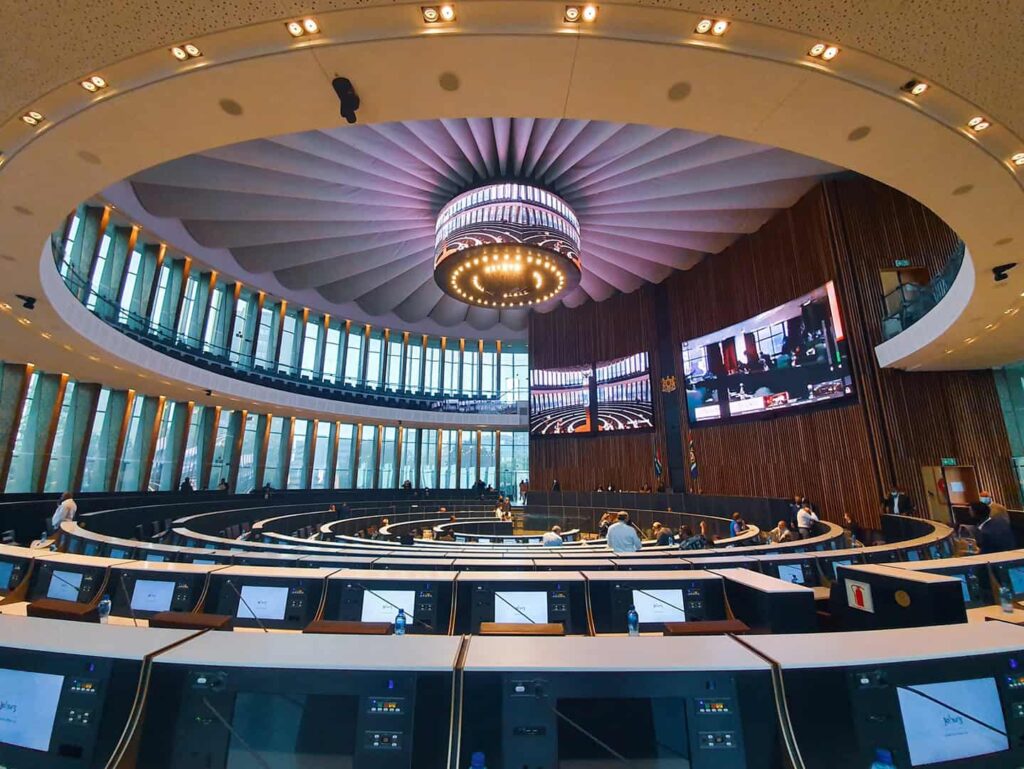








City officials who oversaw the digital automation of the Construction Permit Management System (CPMS) have been hailed as trailblazers for having increased investment across industries, stimulating job creation, expediting spatial transformation, and advancing inclusive economic growth. Several Plan Examiners and Chief Plans Examiners who pioneered the system in the municipality have since received certificates of recognition and excellence for using technological affordances to streamline building plan approval within the envisaged three days.
ome of the top achievers of the day included Mark John Barnes, Leiben Naidoo, Ernestine Jacobs, Ronnie Mokondo, and Mellaney Massyn, each of whom walked home with more than two awards.
Johara Anandlal, Barnes, Sindiswa Dlamini, Ernestine Jacobs, Council Mabeba, Kithue Masu, and Nkamoheleng Mathaba were recognised for outstanding performance in handling voluminous building plans in a superb turnaround time.
Sibusiso Langa, Massyn, Yonela Mwafulirwa, Naidoo, Petrus Sennelo, and Mokondo were recognised for their outstanding performance in making efficient decisions when assessing building plans.
Kedibone Moraladi, Pamela Ndovela, Noel Oberholzer, Aluwani Rambau, Dinga Sandlana, Olga Shibambu, and Andiswa Yilo-Stuurman were also recognised for outstanding performance.
Naidoo and John Sibusiso Nkosi were recognised for their outstanding contributions to the reform action plans.
Andiswa Yilo-Stuurman (1st place), Kedibone Moraladi (2nd place), and Council Mabeba (3rd place) were the other top achievers in the category of outstanding performance in handling voluminous work within an impressive turnaround time. Massyn received the coveted award for demonstrating exemplary leadership qualities that embody the values of the Department of Development Planning. Mokondo, Jacobs, Anandlal, and Dlamini were also recognised for their outstanding leadership abilities.
Sanjay Satishwar Khadua received special recognition for going beyond the call of duty and setting a benchmark for consistent performance that improves customer service.
Glen Maluleke, Nomthandazo Masoga, and Bongani Ngubani received special recognition for going above and beyond the call of duty and setting a benchmark for consistent performance that improves customer service.
The system developed by the officials has since been endorsed and applauded by construction industry bigwigs and stakeholders, as well as the Presidency, the International Finance Corporation (IFC), the Swiss government, the World Bank Group, the Department of Trade, Industry, and Competition, and the National Treasury.
Cllr Belinda Echeozonjoku, Member of the Mayoral Committee (MMC) for Development Planning, said at the awards ceremony on Friday, 20 January, that by pioneering the CPMS, Johannesburg had achieved its goal of becoming a world-class metropolitan city.
Implementing the Construction Permit Management System (CPMS) would put an end to insufficient spatial planning and transform the metro into a modern and inclusive city that serves and protects all residents.
“It is critical for the City to embrace technology and transition to the digital age. The system’s implementation contributes to the concept of transforming Johannesburg into a Smart City, a mayoral priority that promotes the use of technology to improve the ease of doing business.”
She went on to say that the CPMS exemplified the City’s commitment to improving quality standards and customer service.
The Construction Permit Management System (CPMS) was piloted in Johannesburg in January last year to digitise the submission and approval of building plans. Hundreds of building applications have been processed, and over a thousand professionals have successfully registered their profiles on the CPMS.
The manual process of approving building plans was time consuming, limited, burdensome on officials, prone to errors, and overcrowded. The digital CPMS, on the other hand, works efficiently, allowing architectural professionals to submit and have building plans processed remotely within three days.
Cllr Echeozonjoku stated that the CPMS improves the City’s business efficiency, increases investment in the property sector, and improves spatial design and urban planning.
“The system accelerates the construction permit approval process, stems corruption and has moved our processes from manual to digital. We are confident that this will significantly reduce the amount of time developers and architects spend attempting to obtain approval for their work.”
The automation of the City’s construction permit management system, according to Dr Anthony Costa of the Presidency, is a shining example of how state institutions can use technology to create an enabling business environment.
“The construction sector is critical to infrastructure development and job creation, and the City’s CPMS improves the ease of doing business with the municipality, the end user experience, increases efficiencies, grows the economy, and increases investment in the property sector,” Dr Costa said.
He added that the CPMS would boost economic growth in the construction sector and improve the efficiency of doing business with the municipality.
Zunaid Khan, the Executive Director for Development Planning, hopes the CPMS will serve as a model for other municipalities interested in going digital.
“For the customer, the manual process was tedious and time consuming. It took a lot of effort to make the switch to something completely different. It was time for a change; we live in the digital age,” Khan explained.
He added that the City had a new breed of construction customers who wanted things done faster, and the old system was archaic and antiquated for this function. “We’re transitioning, and the team has embraced technology,” he said, expressing gratitude to everyone involved.
Rakesh Beekum of the International Finance Corporation (IFC) advised the City to conduct an audit of its technology as soon as things settled down and to move toward adopting other leading 4IR technological affordances such as Artificial Intelligence (AI), Augmented Reality (AR), and Virtual Reality (VR) to enable people to work remotely from anywhere in the world.
“You have raised the bar, Joburg, well done,” Beekum told award recipients.
20/01/2022