




The Johannesburg Roads Agency (JRA) has joined forces with public and private corporations to address the issue of traffic light outages during loadshedding, aiming to alleviate congestion on the City’s roads. Sipho Nhlapo, Operations Manager: Mobility and Freight at the JRA, says over 150 organisations have expressed interest in collaborating with the JRA, with 30 companies finalising service level agreements (SLAs).
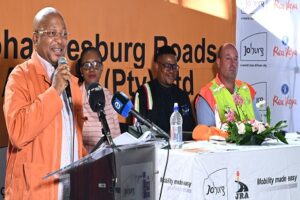 Nhlapo highlights the significant impact of these partnerships on both the JRA and road users.
“Two of the organisations who have signed SLAs with the JRA have indicated that during stage 6 load shedding, their daily electricity costs for supplying power to JRA traffic intersections will amount to only R35.00. This impressive efficiency is partly due to the JRA’s initiative to reduce wattage consumption at traffic signals since 2010. All our intersections are equipped with LED lights, which consume minimal electricity. In fact, powering a traffic signal requires only between 500 and 1000 watts per hour, equivalent to powering a laptop,” he explains.
Nhlapo adds that the JRA manages 2,020 signalised intersections throughout the City, with Region F hosting the majority, approximately 750 intersections, followed by Region G with around 25.
“Every driver in Johannesburg has experienced frustration caused by malfunctioning traffic lights, particularly during peak travel hours. The JRA launched the Traffic Signal Backup Power Initiative to counter this problem,” he notes.
To date, several prominent corporate brands are already on board, including Vodacom, Standard Bank, Waterfall City, Sanlam, St. John’s College, and Sandton Central Management District.
The Traffic Signal Backup Power Initiative forms part of the JRA’s recently unveiled Intelligent Transport System (ITS) Strategy 2027, a forward-thinking plan to enhance Johannesburg’s urban landscape by incorporating Smart City concepts.
Nhlapo says the JRA acknowledges the challenges posed by an unreliable electricity supply and seeks partnerships with organisations equipped with backup power systems.
“The JRA’s Intelligent Transport System (ITS) Strategy 2027 aims to revolutionise travel patterns, accommodating the increased movement of goods and people across the City. The strategy also strives to enhance the City’s competitiveness and improve everyday navigation and living for residents,” Nhlapo explains.
To achieve these goals, the JRA plans to enhance traffic management by deploying smart traffic light systems using Artificial Intelligence (AI) to predict movement patterns efficiently, ensuring smooth traffic flows and enhanced road safety.
“A stable electricity supply is essential for the proper functioning of the JRA’s traffic signal network,” he emphasises.
In the short term, partnering with both private and public SA will result in functional traffic lights, while the long-term benefits include advanced traffic management systems that significantly improve the interaction between pedestrians and vehicles on Johannesburg’s roads.
Nhlapo adds that the JRA has plans to connect all intersections along Chris Hani Road in Soweto.
“Establishing a partnership with the JRA is easy. Interested parties should send an email to hotline@jra.org.za and express their interest in partnering with the municipal entity,” he says.
Written by Brümilda Swartbooi
31/07/2023