






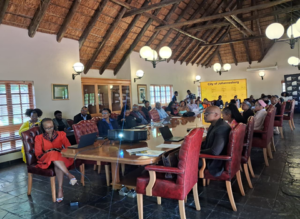
 The City of Johannesburg’s Department of Economic Development has established an Investment Fast-Tracking and Project Prioritisation Team as the “Meet the City” Business Retention Programme continues to roll out across all seven regions of the City.
Speaking during the Region A session, the Executive Director for Economic Development, Mathopane Masha, said the City has strengthened investor support mechanisms by introducing a coordinated fast-tracking team.
“This team brings together all critical departments and municipal entities to expedite processes for investors whether it relates to zoning matters, water licences, or other regulatory approvals,” said Masha.
“Although some procedures may legally take up to two years, that does not mean they should take that long. We are working to significantly reduce turnaround times so that businesspeople can focus on running their businesses,” he said.
The programme has already commenced in regions C, D, E, and A. Entrepreneurs in these areas used the platform to highlight persistent service delivery challenges affecting their operations.
Business owner Norman Tamirametsi from Marlboro said he has been unable to access his office for the past two months due to the deteriorating condition of the Marlboro Industrial area.
“We don’t need funding we need real assistance. Our fathers built townships without external finance. What we need now is a functional environment to operate in,” Tamirametsi said.
Masha said the City’s objective is to identify challenges, address bottlenecks, strengthen stakeholder engagement, and create platforms for collaborative problem-solving.
“In cases where informal traders operate without permits on non-designated spaces, property owners sometimes approach us requesting support to better organise the trading environment. We then collaborate to establish a regulated approach that works for everyone. This model has proven effective in certain areas, and we aim to expand it through strong partnerships with local businesses,” he said.
Phaphedi Phukubje, the Chief Economist in the Department of Economic Development, said the City’s economic growth has slowed markedly since the 2008 global financial crisis and was further impacted by the Covid-19 pandemic.
“The period from 2000 to 2008 was characterised by robust economic activity, with an average annual Gross Value Added (GVA) growth rate of 5.50%. In stark contrast, the years from 2010 to 2024 have been marked by subdued performance, with average GVA growth dropping to just 1.23%,” Phukubje said.
The next sessions take place in regions B and G on 3 December 2025.
Written by Zingiswa Mndayi